December 19, 2025
The Water Formula: How to Drink Correctly for Optimal Body Composition and Better Training
Is water the missing link in your fat-loss journey? Discover the "Cellular Swelling Theory," the truth about water-induced thermogenesis, and the exact Galpin Equation protocol to prevent performance crashes. A science-backed operative guide to hydration architecture.
Table of Contents
(Hydration Architecture for Body Composition and Peak Performance: An Operative Guide)
Executive Summary
Optimizing Body Composition and athletic performance requires precise management of physiological variables. While water is the solvent in which all metabolic processes occur, the current scientific literature demands a balanced approach that distinguishes between proven mechanisms (such as the effect of hydration on cardiac output) and speculative or indirect mechanisms (such as the hormonal effect on lipolysis).
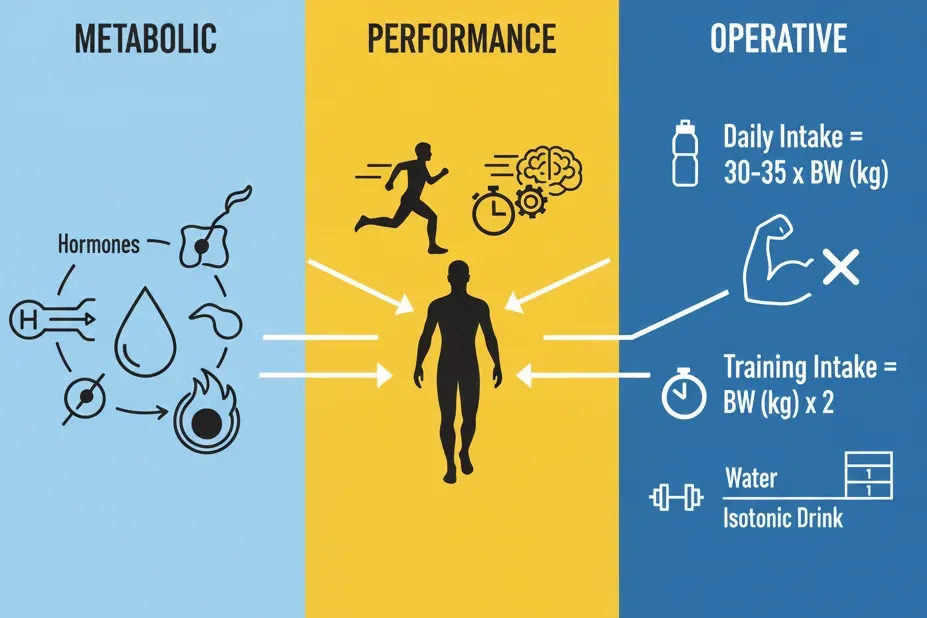
This report provides an action plan based on the current scientific consensus, rejecting popular myths in favor of applied physiology. The report is structured around three axes:
- The Metabolic Axis: The role of water in hormonal regulation and energy expenditure.
- The Performance Axis: Preventing physical and cognitive deterioration and managing muscle cramps.
- The Operative Axis: Quantitative protocols for fluid and electrolyte intake.
Part 1: Water and Weight Loss (Biochemical Mechanisms)
Hydration is not a substitute for a caloric deficit, but it serves as a Permissive Condition that allows metabolic systems to function with maximal efficiency.
1.1 Lipolysis and Hormonal Environment
The Angiotensin Axis (RAAS) and Fat Management
Chronic or acute dehydration activates the Renin-Angiotensin System (RAS) to conserve fluids. High levels of the hormone Angiotensin II have been linked in studies to increased insulin resistance and the promotion of lipogenesis (fat storage) in white adipose tissue. The rationale is that adequate hydration suppresses the Angiotensin axis, thereby removing a potential "brake" from the fat-burning systems.
Clinical Caveat: It is important to note that most evidence linking Angiotensin II to lipogenesis comes from rodent models and chronic diseases (such as hypertension and obesity). The direct relevance of this mechanism to healthy athletes experiencing temporary fluctuations in hydration has not been fully proven in human clinical trials.
The Cellular Swelling Theory
A well-established theory in cell physiology, extensively researched by Haussinger and others, posits that cell volume serves as a primary metabolic signal. A state of good hydration creates osmotic pressure that causes slight "cellular swelling." This state is recognized by the cell as an anabolic (building) signal, which promotes protein and glycogen synthesis and inhibits proteolysis (muscle breakdown).
- Significance: Maintaining hydration is essential for preserving Lean Mass during a hypocaloric diet, which helps maintain the Resting Metabolic Rate (RMR).
1.2 Thermogenesis: The Numerical Reality
The thermogenic effect of cold water exists, but it is significantly more modest than what was presented in early studies. Current meta-analyses show that drinking 500 ml of cold water (3°C) increases resting energy expenditure by only about 4.5% for approximately 60 minutes.
- The Bottom Line: An addition of about 40-80 calories per day with high intake. This is a nice "bonus," but not a central weight loss strategy.
1.3 Satiety: An Age-Dependent Strategy
Drinking water before a meal (Pre-loading) is an effective tool for hunger management, but its efficacy varies demographically. Studies have shown that drinking 500 ml of water 30 minutes before a meal reduces caloric intake at that meal by about 13% in middle-aged and older adults, but the effect in younger individuals (ages 20-35) is less consistent due to stronger hunger mechanisms.
However, replacing sweetened beverages with water remains the most effective fluid-related intervention for weight loss.
In this axis, the link between water and results is direct, measurable, and critical.
The scientific literature consistently identifies a fluid loss of 2% of body weight as the threshold point where significant impairment in aerobic and cognitive performance begins.
- Cardiovascular Drift: A decrease in plasma volume reduces the heart's stroke volume. To maintain cardiac output, heart rate increases disproportionately to the effort, which accelerates fatigue.
- Cognitive Impairment: Mild dehydration harms concentration, reaction time, and coordination – critical elements in technical and team sports.
2.2 Exercise-Associated Muscle Cramps (EAMC): A Paradigm Shift
The modern perception of Exercise-Associated Muscle Cramps (EAMC) has shifted from "salt deficiency" to a "neurological problem."
- The Neuromuscular Theory: Muscle fatigue causes an imbalance in neural signaling within the spinal cord: over-excitation of the Muscle Spindles and a reduction in the inhibitory signals from the Golgi Tendon Organs (GTO).
- The Role of Water: Dehydration is not the direct cause of the cramp, but it accelerates muscle fatigue and thus constitutes a significant indirect risk factor.
Part 3: Practical Application (Operative Guide)
Without exercise, an active person requires a basic amount for physiological support:
$$\text{Daily Intake (ml)} = 30-35 \times \text{Body Weight (kg)}$$
(Example: An 80 kg person = 2.4-2.8 liters per day).
3.2 Training Protocol: The Galpin Equation
To prevent the "2% drop" and maintain optimal absorption, it is recommended to use the Galpin Equation, based on the findings of Fallowfield et al. (1996) which demonstrated a 33% improvement in endurance under this protocol ,:
During Exercise:
$$\text{Intake every 15-20 minutes (in ml)} = \text{Body Weight (in kg)} \times 2$$
(Example: An 80 kg athlete should drink about 160 ml every fifteen minutes).
Full Protocol for a Training Day
- Pre-Training (The Prime): Drink 5–7 ml/kg about 4 hours before training. If urine is dark, add 3–5 ml/kg about 2 hours before.
- Intra-Training (The Sustain): Apply the Galpin Equation. For workouts over 60 minutes, consider an isotonic drink.
- Post-Training (The Restore): Replenish 150% of the fluid weight lost (weighing before and after). The additional 50% covers ongoing urine production.
3.3 Decision Table: Water vs. Sports Drinks
| Scenario |
Fluid Type |
Scientific Rationale |
| Workout < 60 minutes |
Plain Water |
No significant glycogen depletion; water supports lipolysis without caloric addition. |
| Workout > 60 minutes |
Isotonic (6-8% Carb) |
Glycogen and sodium depletion become performance limiting. Energy and salt supply is required. |
| Heavy Sweating / Heat |
Water + Electrolytes |
Prevents hyponatremia (dilution of blood salts) without unnecessary caloric load (if the goal is body sculpting/cutting). |
References